We’re seeing some realistic postings beginning to creep onto the Boycott Countdown Facebook page.
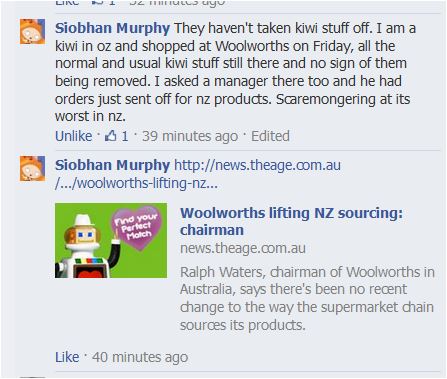
This from Siobhan Murphy, a New Zealander living in New South Wales, Australia who says people supporting the page are scaremongering and NZ produce is still on sale in Australia:
Ashamed to be a Kiwi
Australian Farmers and what their real life is, trying to stay alive, trying to keep their farms that have been in their families for generations from being lost altogether. And you kiwis want to put a knife in their backs – I can tell you as a kiwi living in oz, how disgusting your actions are, jeopardising NZers jobs in NZ and also in Australia.
You are acting from scaremongering. Woolworths have not pulled nz stock from shelves in Australia – that is 109% fact. You are jeopardising the jobs of all nz employees of countdown in Nz and many in Australia as well as the livelihoods of many innocent Aussies.
Kiwis are looking terrible on the international stage, international forums are starting to slam kiwis. You fools.The mentality shown on this page makes me ashamed to be a kiwi.
http://aussiehelpers.org.au/category/farmer-stories/
They haven’t taken kiwi stuff off. I am a kiwi in oz and shopped at Woolworths on Friday, all the normal and usual kiwi stuff still there and no sign of them being removed. I asked a manager there too and he had orders just sent off for nz products. Scaremongering at its worst in nz.

 E2NZ.org
I first heard about this from a relative in NZ and was really confused – “what campaign to not stock NZ products?”.Never heard of it and we are in Oz and shop at Woolies.
And even if they did decide to go with local suppliers, isn’t that just market forces at work? It’c common knowledge that Coles and Woolies here in Oz are moving to focus on their own store brands are are squeezing their suppliers to the last dollar so this is just a part of that whole approach not some “we hate NZ” deal.
None of the boycott Countdown thing makes sense to me.
I started up this discussion a few days go and left it to run, just to see what would happen.
Surprisingly, not too many fanatics… That said i did leave it in gen. discussion..
http://www.trademe.co.nz/Community/MessageBoard/Messages.aspx?id=1391374&p=1&topic=5
Poor logic, boycotting one half increases the power of the survivor and creates a monopoly. How does that benefit the suppliers any more than a duopoly does?
I’m not sure how prepared you are to hear another point of view, but I’ll give it go. I agree that if this was just about Australian supermarkets allegedly pulling NZ stock off their shelves then a boycott of Countdown isn’t the way to go.
However, the allegations that Shane Jones raised are a different matter. Australia has been investigating this for a year with their own supermarket duopoly. The UK (which has 4 companies controlling the supermarket industry) did the same a few years ago, came up with a voluntary code of ethics which failed and had to look at more punitive steps to take. In both Australia and the UK, the imbalance of power between supermarket and supplier, and the imbalance of power between supermarket and consumer, have led to abusive positions being taken. In NZ, the same is being alleged by Shane Jones.
What the imbalance means is that all the business risks are pushed onto the supplier and away from the supermarket. Whether it is a NZ supplier or an Australian supplier is irrelevant. The supplier bears the cost of packaging, distribution, warehousing, advertising, supermarket specials, supermarket price wars, shelf-stacking and, it appears, prior year losses. The supermarket is effectively a risk-free entity. This means it can exert any sort of price control and its margins are untouched. This leaves suppliers, like the ones Siobhan Murphy above refers to, in a very vulnerable position – and their employees in an even more vulnerable position as costs need to be slashed. The less powerful the supplier’s brand is, the more the supermarket can push the risks on to them and force their prices down. The perfect supplier for the supermarket is the one who supplies for their in-house no-frills brand, because this supplier has no brand strength at all.
You might think this is great because it means lower prices for the supermarket shopper. It doesn’t. When supermarkets make it all about a price war and as suppliers’ positions are weakened, the supermarket can insert its home-brand into the gap. Suppliers are led to the position where they have to start supplying for the supermarket’s homebrand or go bust. When the homebrand takes a commanding share of the sales, the competition dries up and the supermarket can reduce choice and push prices up.
Boycotting one half of a duopoly is a good thing – it weakens the structure and it causes the other half of the duopoly to have a panic as well. It is to the benefit of Australian and NZ consumers as well as the suppliers of both countries, not to mention their employees.
On TradeMe today: http://www.trademe.co.nz/Community/MessageBoard/Messages.aspx?id=1391795&topic=7